Pest Science Group
School of Applied
Residential Pest Science
The School of Applied Residential Pest Science was established by Pest Science Group to advance the professional practice of residential pest management through the coordinated study and application of science.
Introduction.
Residential pest management is a profession that protects homes, property, health, and quality of life. Every day, practitioners make decisions that influence the safety, comfort, durability, and pest resistance of the homes they serve. These decisions require far more than product knowledge alone. They require an understanding of pest biology, building science, environmental conditions, structural systems, healthy housing principles, critical thinking, observation, and professional judgment.
The concept for the School began developing in 2017 through the study of thousands of residential properties, field observations, product evaluations, exclusion projects, building performance investigations, and pest management case studies. Throughout this work, one consistent observation emerged: the most successful pest management outcomes occur when scientific knowledge is intentionally integrated with practical field experience.
The School was formally established in 2027 to provide a structured educational pathway that coordinates scientific study with daily professional practice. Rather than separating education from work, practitioners study concepts while simultaneously applying them in the field under structured guidance, observation, discussion, mentorship, and evaluation.
The School does not seek to replace universities, professional associations, manufacturers, licensing agencies, or continuing education providers. Instead, it builds upon their contributions by integrating education from multiple disciplines into a coordinated learning model focused specifically on Applied Residential Pest Science.
Purpose
The purpose of the School of Applied Residential Pest Science is to educate and develop Applied Pest Science Practitioners capable of applying scientific principles to residential pest problems through observation, diagnosis, intervention, evaluation, and continuous improvement.
The School exists to:
- Advance residential pest management as an applied scientific profession.
- Coordinate scientific education with supervised field application.
- Integrate entomology, building science, healthy housing, structural diagnostics, exclusion, integrated pest management, and environmental science into a unified educational framework.
- Develop professional judgment through observation, critical thinking, mentorship, and practical experience.
- Promote evidence-based decision making and continual learning.
- Develop standards, research, case studies, educational programs, and professional competency for the advancement of the profession.
The PSG Coordinated Learning Model.
The School follows a coordinated educational model where scientific study and professional practice advance together.
Study
Scientific principles are learned through universities, professional organizations, technical literature, PSG instruction, research publications, and independent study.
Observe
Students observe and evaluate conditions in actual residential environments while developing their understanding of pest biology, building performance, and environmental influences.
Diagnose
Students learn to identify root causes through structured inspections, analysis, critical thinking, and evidence-based decision making.
Intervene
Students perform appropriate structural, biological, educational, and environmental interventions under established company standards and professional mentorship.
Evaluate
Students measure outcomes, document observations, discuss findings, analyze results, and continuously improve professional judgment.
This continuous cycle transforms scientific knowledge into professional competence.
Educational Philosophy.
The School believes that professional competence cannot be developed through classroom instruction alone.
Knowledge is acquired through study.
Competence is developed through application.
Professional judgment is developed through experience, observation, reflection, mentorship, and continuous improvement.
For this reason, practitioners enrolled in the School continue performing their professional responsibilities while simultaneously participating in structured educational programs. Each lesson is intentionally coordinated with field assignments that reinforce classroom concepts through real homes, real pest problems, and real interventions.
Education and professional practice are not separate activities. They become one continuous process of learning, applying, evaluating, and improving.
Current Educational
Model.
The School currently delivers its educational programs through Pest Science Group's affiliated teaching practices:
PSG Pest Management
Students remain active, licensed pest management professionals while participating in the School. Their daily professional responsibilities become an extension of the educational process.
Rather than separating classroom education from employment, the School coordinates scientific study with daily field experience. As concepts are introduced, students immediately apply them through inspections, diagnostics, structural interventions, pest management services, customer education, documentation, and case study review.
The School believes professional competence is best developed when scientific education and practical experience occur simultaneously.
Current Admission Requirements.
The School of Applied Residential Pest Science is currently designed for licensed pest management professionals actively employed within a PSG-affiliated teaching practice.
As the School continues to develop, additional educational pathways may be established for future practitioners, university students, researchers, educators, and affiliated industry professionals.
Applicants must
- Hold all state pest management licenses required for their position.
- Be actively employed by a PSG-affiliated teaching practice, currently Seal Out Scorpions or PSG Pest Management.
- Demonstrate a commitment to professional development and lifelong learning.
- Participate in classroom instruction, field application, mentorship, competency evaluations, and case study development.
Professional Philosophy.
The School was established from the belief that residential pest management deserves a structured educational model that reflects the importance and complexity of the profession.
Residential structures are dynamic systems influenced by biology, construction, moisture, airflow, environmental conditions, human behavior, landscaping, and maintenance. Effective pest management requires an understanding of how these systems interact.
The School believes that practitioners should not only understand how to perform pest management services, but why those services are performed, when they are appropriate, how they affect the residential environment, and how they contribute to long-term pest prevention.
Applied Residential Pest Science is therefore not simply the study of pests.
It is the scientific study and professional application of the biological, structural, environmental, and human systems that influence residential pest activity and the interventions used to improve the health, performance, and pest resistance of residential structures.
Instructors.
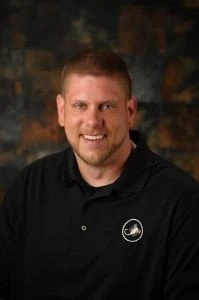
Mike Golleher, B.S., BP-A, BP-T
Cohort Instructor · School of Applied Residential Pest Science
Structural Field Master Specialist · Seal Out Scorpions
Mike Golleher serves as a Cohort Instructor for the School of Applied Residential Pest Science and as the Structural Field Master Specialist for Seal Out Scorpions.
Mike holds a Bachelor of Science in Interdisciplinary Studies from Grand Canyon University, with academic concentrations in Education, Psychology, and Biology. He is a Building Performance Analyst (BP-A) and Building Performance Technician (BP-T) through the Building Performance Institute (BPI) and is a Certified Applicator licensed through the Arizona Department of Agriculture, Office of Pest Management.
Areas of Instruction
Mike provides instruction and professional mentorship in:
- Applied Residential Pest Science
- Building Performance Sealing™
- Structural Pest Intervention
- Integrated Pest Management (IPM)
- Residential Building Science
- Building Performance Institute educational programs
- Healthy Housing Principles
- Residential structural diagnostics
- Pest Barrier Integrity Systems
- Residential door performance and diagnostics
- Building envelope evaluation
- Air leakage diagnostics
- Pest entry point identification
- Structural exclusion systems
- Field craftsmanship and installation standards
- Professional documentation
- Applied field standards
- Field competency development
Read more about Mike
As one of the Applied Field Developers of Building Performance Sealing™, Mike has helped develop, refine, document, and teach the structural methods, field practices, and applied science that have evolved through Seal Out Scorpions since 1999. His work integrates building science, structural diagnostics, pest management, and professional craftsmanship to improve the performance of residential structures as barriers against pest intrusion.
Within the School, Mike leads study cohorts through the PSG Coordinated Learning Model, where participants integrate scientific study with practical field application. He facilitates discussion, field application, competency development, and professional mentorship while participants progress through educational programs offered by recognized organizations, including the Building Performance Institute (BPI).
As the Structural Field Master Specialist for Seal Out Scorpions, Mike works alongside practitioners in the field, helping develop professional judgment through observation, diagnostics, structural intervention, craftsmanship, documentation, coaching, and continual improvement. His active field leadership allows classroom instruction to remain closely connected to real residential structures and the performance challenges they present.
Educational Leadership
Mike leads study cohorts and facilitates learning through educational programs developed by the Building Performance Institute (BPI) while integrating those concepts with the practical application of Building Performance Sealing™ and Structural Pest Intervention.
Through the PSG Coordinated Learning Model, participants study building science while simultaneously applying those concepts through inspections, diagnostics, Building Performance Sealing™, structural interventions, and residential building performance evaluations.
His instruction emphasizes the relationship between building performance and residential pest prevention, helping practitioners understand not only how structural interventions are performed, but why they improve the long-term performance of the home as a barrier against pest intrusion.
Educational Philosophy
Mike believes that effective structural pest intervention is achieved through the integration of science, observation, diagnostics, craftsmanship, and continual improvement.
His instructional approach emphasizes critical thinking, precision, quality workmanship, and measurable performance. Students are encouraged to understand the relationship between building science, residential construction, and pest management while developing the skills necessary to perform structural interventions to a consistently high professional standard.
Rather than separating education from professional practice, participants immediately apply classroom concepts through their daily work, allowing scientific knowledge to develop into professional judgment through repetition, mentorship, and experience.
His objective is not simply to prepare participants to complete educational programs or earn certificates, but to help develop Applied Pest Science Practitioners capable of improving the performance, durability, and pest resistance of residential structures through scientific understanding, professional craftsmanship, and applied field experience.
Jeremiah Sourp, QP
Cohort Instructor · School of Applied Residential Pest Science
Field Manager · PSG Pest Management
Jeremiah Sourp serves as a Cohort Instructor for the School of Applied Residential Pest Science and as Field Manager for PSG Pest Management.
As a licensed Qualifying Party (QP) through the Arizona Department of Agriculture, Office of Pest Management, Jeremiah combines professional field leadership with scientific education and practitioner development.
Areas of Instruction
Jeremiah provides instruction and professional mentorship in:
- Applied Residential Pest Science
- Entomology
- Integrated Pest Management (IPM)
- Residential pest inspections
- Pest identification
- Pest biology and behavior
- Residential pest diagnostics
- Biological pest interventions
- Pesticide selection and application
- Monitoring and evaluation
- Customer communication
- Professional documentation
- Case study development
- Professional field standards
- Field competency development
Read more about Jeremiah
Within the School, Jeremiah leads study cohorts through the PSG Coordinated Learning Model, where participants integrate scientific study with daily professional practice. He facilitates discussion, field application, competency development, and professional mentorship while participants progress through educational programs offered by recognized organizations including Purdue University and the Entomological Society of America (ESA).
As Field Manager for PSG Pest Management, Jeremiah works alongside practitioners in the field, helping develop professional judgment through observation, diagnostics, intervention, documentation, coaching, and continual improvement. This active field leadership allows classroom instruction to remain closely connected to real residential pest management challenges.
Educational Role
Jeremiah guides participants through structured educational programs developed by organizations such as:
- Purdue University
- Entomological Society of America (ESA)
He helps participants understand scientific concepts while applying those concepts during daily residential pest management services through observation, discussion, mentorship, and field evaluation.
Educational Philosophy
Jeremiah believes that professional competence is developed through the coordinated integration of scientific study, professional mentorship, and practical field experience.
His instructional approach emphasizes observation, critical thinking, diagnosis, intervention, evaluation, and continual improvement.
Rather than separating education from professional practice, participants immediately apply classroom concepts through their daily work, allowing scientific knowledge to develop into professional judgment through repetition, mentorship, and experience.
His objective is to help develop Applied Pest Science Practitioners capable of applying scientific principles to real-world residential pest management challenges.
Join the School of Applied Residential Pest Science
The School admits licensed pest management professionals employed within a PSG-affiliated teaching practice. Tell us where you are working and we will take it from there.